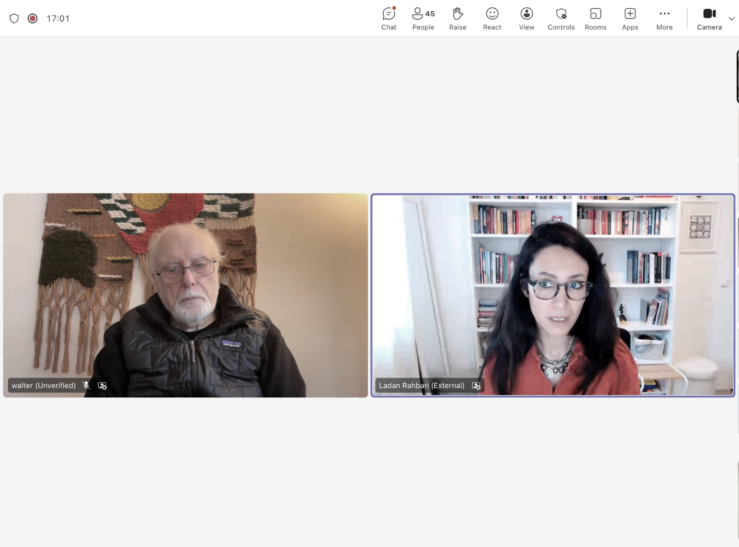
This is a short version of the talk I gave for the seminar called “Embodied Dignity: Worthy bodies: incarnated moralities” on December 9, 2025, 15h to 17h (UTC+1), at KULeuven. In the seminar, Walter Mignolo and I discussed the notion of embodied dignity in decolonial theory.
***
I was given the assignment to begin with the question of grounding: where am I coming from? What does this talk have to do with myself as a person and as a scholar? And then to speak about embodied dignity— and I want to approach this a bit differently.
So instead of separating the two, my grounding and the question of dignity, from the very start, I will weave the notion of embodied dignity into my grounding.
So, what I will do in this short talk is to speak about that grounding in relation to the notion of embodied dignity and I will also be in conversation with Walter Mignolo’s work, especially some of his concepts and arguments developed in his two major projects The Darker Side of the Renaissance and The Darker Side of Western Modernity.
To begin: in a guest lecture I gave a few weeks ago, the colleague who invited me asked how I chose to study gender. I gave a spontaneous and rather disorganized answer at the time, but later I realized that I actually never chose to study gender at all. In fact, gender chose me.
Growing up in the 1980s and 1990s, in a working-class family in an ethnic minority household in provincial Iran, gender pre-defined many things about me before I even existed. My dignity—and my sense of dignity—were formed in interaction with those pre-existing notions.
Very early on, girls in my environment had to learn how to answer a very crucial question to be able to exist: Who is a dignified woman? And the answer to this question had everything to do with the body. How the body is shaped—its size, curves or lack thereof—where the body is taken, what one wears on the body, how one walks, sits, even what and how one eats … all of these were directly tied to the idea of a dignified woman.
During the three decades in which I lived, studied, and later worked in Iran as a lecturer and researcher, I confronted an intense surveillance of the female body—something I have written extensively about in my work. I wrote about the covering of the female body in the name of dignity and morality; I wrote about beauty practices and the way they reshape the body to achieve an aesthetic ideal that is in fact unachievable; and the absurd rules of body management and morality that sustain the discourse around the so-called dignified woman’s body.
This excessive obsession with regulating the feminine body is of course a result of gendered structures of power, in which women and queer bodies are pushed to the peripheries. But, as Sara Ahmed states, what is pushed to the margins is often precisely what sits at the center of thought. So, while the obsession marginalizes the feminine body, it also places that body at the core and the center of the ideology. In my work on Iranian nationalism, I have shown how the “female body” actually bears the weight of national identity.
This resonates with Walter Mignolo’s argument that the construction of the Indigenous body as monstrous and subhuman in the European imaginary is the mechanism through which the white European body becomes normalized.
Later, when I moved to Europe, I was confronted with a new question that came to me because of going through migration: Who is a dignified migrant woman? And again, the question turns on the body.
What does a dignified migrant woman’s body look like? What does she do with her body? How many children does she have? The dignified migrant woman from the so-called Middle Eastern or Muslim background must show that her body is liberated by being economically productive, BUT not reproductive.
She must work, because within the migrant integration discourse in Europe, she has to prove her worth by clearly demonstrating that she will not be a burden on the economy and welfare.
But she should not reproduce because reproduction does not align with the expectations placed on a liberated brown, but still suspiciously Muslim-looking body—only white European women are allowed to make babies; Middle Eastern women are imagined as reproducing risks and threats that may take over the continent. (think about all the population replacement theories that are becoming re-popularized in Europe)
Another part of that liberation of this migrant woman revolves around: What she wears. She has to show she is liberated by adopting European fashion.
She cannot cover her body, because that would be framed as the ultimate anti-civilizational act. After all, the feminine body in the West, and especially the Orientalized body of a feminine subject has long been constructed as the object of perpetual colonial and sexual gaze—how dare she cover it?
Of course, colonialism has always had its own aesthetics (from the very onset of it), and those aesthetics sometimes return in very blatant ways: Think about the way European news channels openly stated that they cared about the lives of Ukrainian refugees because of their blue eyes and blond hair.
Black and brown bodies of other refugees are considered as dirty, monstrous, disgusting, leaky, excessively multiplying…and so on. They are not dignified and are not the subject of our empathy.
This discourse is not always blatant, and also returns hidden in the language of white humanitarian feminism that claims to liberate and “beautify” the Middle Eastern woman by freeing her from the veil—the Afghan, the Iranian, the Iraqi, the Palestinian woman…who must be liberated not only from their political suppressers but also from themselves if they happen to choose to veil themselves. There are no other dignified ways of living than the ones that the metropole accepts.
It is not accidental that in 2001, Laura Bush (the first lady of the US), borrowed the language of women’s rights as human rights, by saying that “the fight against terrorism is also a fight for the rights and dignity of women,” (Bush 2001). (I am quoting from Mimi Nguyen’s paper, here)
In 2003, George W Bush said the same thing about Iraqi women: that they must be liberated by war; their liberation in the name of civilization is so important that justifies their mass killing
This very year, after two years of Gaza’s genocide, Benjamin Netanyahu mocked feminist activism to support Palestine and said: “The women of Gaza are property, they’re nothing, they have no rights, they’re completely subjugated” – to defend the massacre of civilians in Gaza, many of whom were those same women and children
On June 13, 2025, when Israel attacked Iran, Netanyahu used the slogan “Women, Life, Freedom” which is popularized by Iran’s civil uprising, to claim he was paving the way for Iranians to save themselves from the Iranian regime.
So, as Jasbir Puar states it death becomes… a form of collateral damage in the pursuit of life.
And as Judith Butler says, there is an aesthetic dimension to war that aims to exploit and instrumentalize visual aesthetics as a war strategy.
Going back to my grounding, there is yet another question that I have to answer almost on a daily basis: Who is a dignified migrant academic woman?
I think about this constantly as I go to work: teaching classes on race, gender, migration, and coloniality in Europe. As I write grants and papers and get rejections and comments that say that: The scholarly contribution of my work is not clear, because I work on Iran and not on Europe. I have to convince committees, editors, and reviewers that studying “the other” is not an exception to the rule. That the world does not revolve around Europe and the white body.
In a book I recently co-edited with my friend Olga Burlyuk, we use the metaphor of “the asshole of the world,” which is a term provocatively introduced by feminist scholar Larissa Pelucio, to discuss how the West positions itself as the center of knowledge production—the brain of the world—while the rest of us are imagined as merely processing its outputs and producing waste.
But beyond these geographies of knowledge production, Walter Mignolo offers a bio-graphic way of thinking as well. He says that there is a body-politics of knowledge, that knowledge production is aligned not only with specific geographies, but also with particular bodies.
The body of the migrant academic woman is not recognized as a site of knowledge production, no matter where it is. Shifting the focus from geography to the body also helps explain why we feel so exhausted and frustrated in the European academy.
Because to be a dignified migrant academic woman is an impossible thing. The combination collapses as soon as you place the words together.
But within that impossibility, there is also a space for transformation that resonates with what Walter Mignolo calls border thinking: a way of existing in liminal spaces that makes it possible to reverse the logic of modernity-coloniality.
To imagine re-existence (not only resistance) by thinking of different modes of being, knowing, and living…in those borders.
Because coloniality creates conditions in which being a dignified person or a human is not afforded to everyone. But for those of us dwelling in the borders, we have & do come up with ways to exist every day.
Although there is, of course, a huge burden to be dwelling on the borders that is carried by our bodies too: our tense shoulders, dry mouths, fast beating hearts, the uneasy and heavy load of existing in spaces in which our existence is not valued, that our bodies have to deal with.
And knowingly, we do lend our bodies marked with gender, race, and difference to colonial epistemological machinery, to prove its so-called diversity and inclusion.
Let me go toward closing this talk by saying that my focus has remained on our individual and collective bodies:
But as a student of Donna Haraway and Walter Mignolo, I have also learned that we become what we are by being part of a constellation of human and non-human entities.
So just like wars and genocides that target our collective bodies, environmental destruction, colonial extraction of land, using peripheries as dumping sites for our waste, mass deforestation, tourist exploitation – all attack the ecological systems that make living possible. Undermining the conditions of life, the attack on the dignity of the earth, is also an attack on the dignity of those bodies inhabiting it.
To borrow Annibal Quijano’s matrix of power: as the enduring global structures of dominance, dependence, and extraction continue. Not only the lasting destructive legacies of colonialism, but also neocolonial modes of extraction and domination continue to exist.
And these different modes of colonial extraction strip people of the very material resources they need to exist, like land, air, and water.
So, thinking about the 3 questions I asked, I want to also add a few final questions: Who is a dignified human? Or to more accurately think with Walter Mignolo’s body-politics, which bodies are legitimized as dignified humans?
And finally, how can those bodies come together, against the persisting dehumanizing and violent colonial structures, to envision a mode of re-existence?
Let me stop here.
Published by Ladan Rahbari